

Why Automating AI Model Selection Is Essential for Production Environments
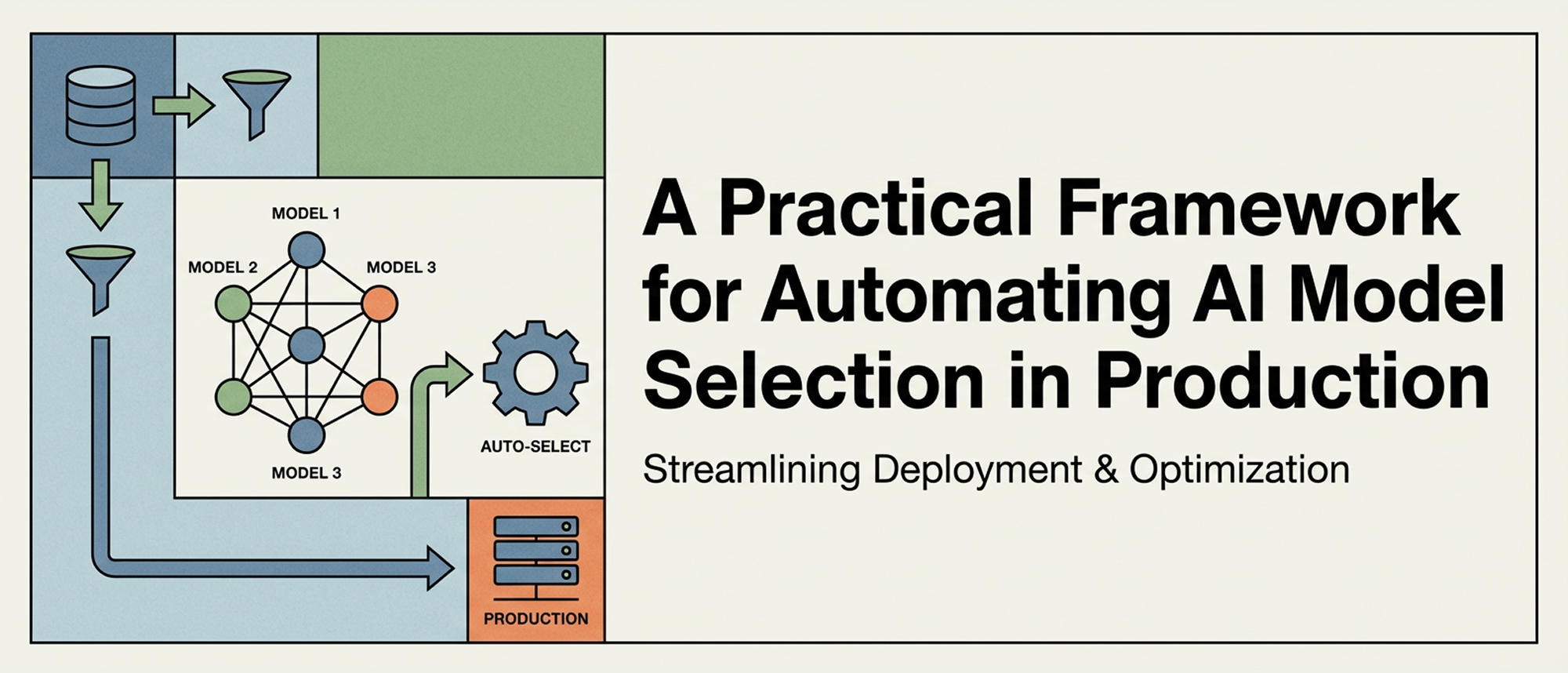
Automating AI model selection means enabling your production system to choose the best available model for every request—based on real-time metrics like cost, latency, stability, and output accuracy.
In large-scale environments, model performance and pricing fluctuate continuously. Manual selection becomes inefficient and risky, often leading to downtime or unnecessary cost spikes.
Automation transforms your architecture into adaptive orchestration, allowing the system to:
- Use the most performant model for each specific use case
- Reduce expenses by routing simpler requests to less costly models
- Maintain reliability with automatic failover when a provider is temporarily unavailable
In essence, automated model selection ensures your AI always runs at peak efficiency without human intervention.
Defining Measurable Model Performance Indicators
Before you can automate selection, you must define what “best model” truly means for your application.
This process begins with establishing quantifiable metrics you can track and compare across providers:
| Metric | Description | Common Data Source |
|---|---|---|
| Latency | Response time under production load | API logs, benchmark tests |
| Cost per Token/Request | Direct cost of execution | Billing analysis |
| Accuracy/Quality | Output correctness and relevance, measured via human feedback or scoring pipelines | Evaluation frameworks |
| Stability | Frequency of errors, timeouts, or degraded responses | Monitoring dashboards |
Each metric should be assigned a weight based on business priority—for example, latency-first for real-time chat systems, or cost-first for high-volume batch processing.
Building a Unified API Layer for Cross-Model Compatibility
A unified API layer is the structural foundation of automation. It abstracts model-specific details, ensuring the routing logic operates independently from differences in model providers.
With a well-designed unified API, you can:
- Send identical payloads to multiple models for testing and benchmarking
- Collect standardized logs and performance metrics
- Switch or fail over between models without refactoring application code
This abstraction enables dynamic model routing, future-proofing, and simplified maintenance as the ecosystem evolves.
Implementing Intelligent Routing and Fallback Logic
Once your unified API is in place, you can implement routing logic to dynamically choose the best model for each request.
Common strategies include:
- Threshold-Based Routing: Models are selected only if they meet latency, stability, or cost requirements.
- Scoring Algorithms: Weighted formulas evaluate multiple metrics at once and compute the best option.
- Machine Learning Routing: Predictive models trained on performance logs determine which AI model will perform best under current conditions.
- Fallback Logic: Automatically retry or reroute requests when failures occur.
- A/B Evaluation: Test new models in shadow mode to gather live performance data before full rollout.
Combined, these mechanisms create a self-correcting system that balances speed, cost, and quality.
Continuous Monitoring and Adaptive Optimization
Even fully automated systems rely on strong observability.
Monitoring frameworks should track metrics such as:
- Response time trends by model and region
- Cost changes across providers
- API success and failure rates
- Output consistency and quality drift
Automated alerts and data-driven dashboards enable rapid intervention when performance shifts occur.
True automation isn’t static—it evolves as models, vendors, and workloads change.
Example: How a Multi-Provider Orchestration System Operates
Imagine a global platform handling chat, summarization, translations, and generative responses:
- Lightweight tasks are routed to cost-efficient models
- Complex reasoning queries go to high-performance models
- Routing selects the nearest server location to minimize latency
- If any provider experiences downtime, traffic shifts seamlessly to alternatives
All of this occurs behind a single API interface, providing stability and resilience without operational friction.
From Multi-Model Management to Intelligent Infrastructure
Automating AI model selection is not just a technical upgrade—it’s an evolution in system design.
When implemented correctly, automation transforms static deployments into self-optimizing ecosystems capable of adapting to:
- Pricing changes
- Infrastructure degradation
- Model quality improvements
- New model releases
This approach enables predictable scaling, cost control, and long-term deployment stability.
开桥: The Next Step in Intelligent Model Automation
开桥 represents an advanced layer of automation for enterprise-grade environments.
As an AI API gateway with model insurance and dynamic optimization, it not only automates model routing but also guarantees reliability—compensating for slow or poor-quality responses.
Key capabilities include:
- Access to top global models (OpenAI, Anthropic, Google, Qwen, DeepSeek, Moonshot, and more)
- Global edge routing for ultra-low latency requests
- OpenAI-compatible API for frictionless integration
- Insurance-level guarantees for response quality and stability
开桥 elevates orchestration into a secure, intelligent infrastructure—reducing operational risk while ensuring consistent performance at scale.
Final Thought
Automating AI model selection isn’t just a convenience—it’s now a competitive advantage.
As intelligent routing, observability, and reliability layers mature, organizations that adopt automation will experience better scalability, lower costs, reduced failure risk, and faster innovation cycles.