
Understanding How an AI API Gateway Works
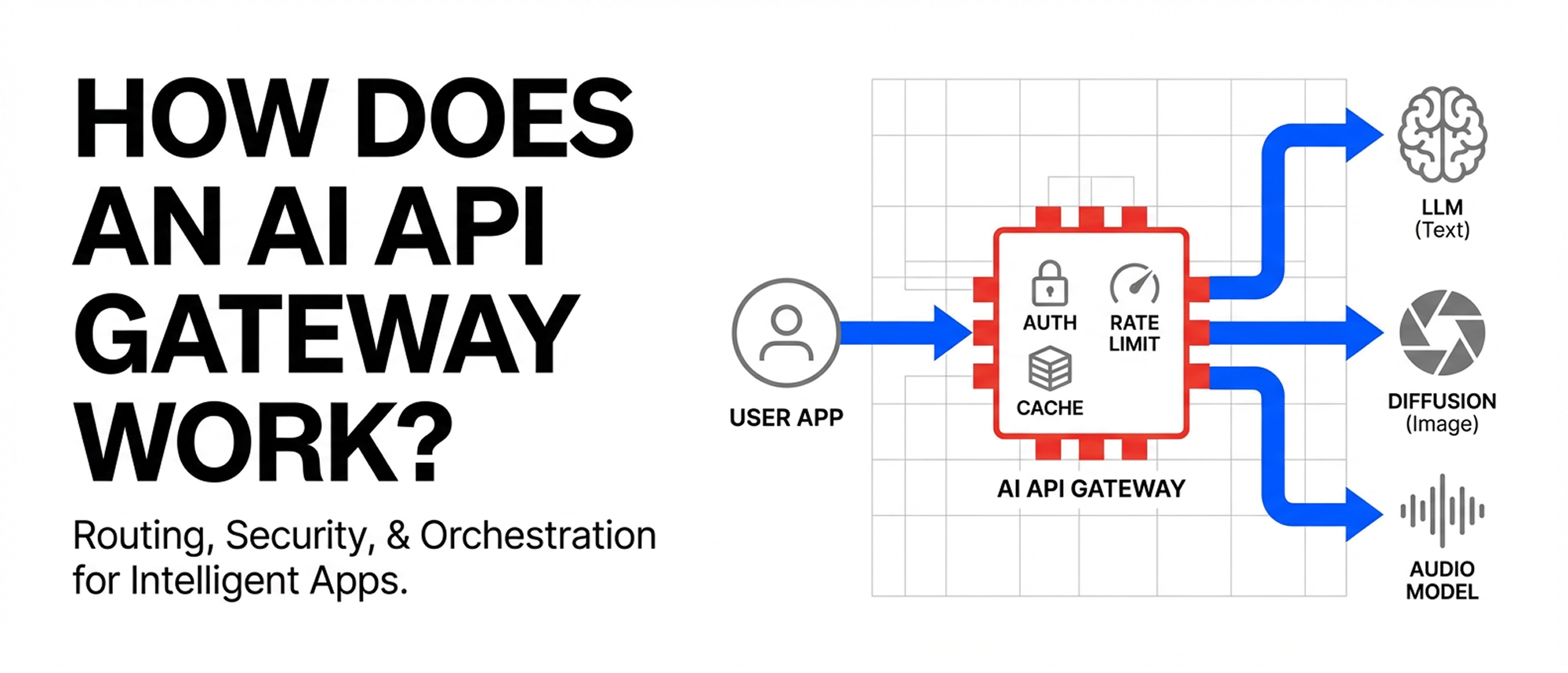
An AI API Gateway acts as the intelligent control layer between your applications and AI model endpoints — such as large language models (LLMs), vision systems, and speech recognition APIs.
It routes, manages, and secures traffic between clients and AI providers. In essence, it’s the middleware that ensures every AI request is efficient, compliant, and cost-controlled.
Rather than connecting directly to OpenAI, Anthropic, or Google APIs, developers send all requests to the AI API Gateway. The gateway then handles routing, authentication, logging, moderation, and even response optimization before returning the result to the client.
This architecture creates a single, unified point for managing multiple AI models, eliminating complexity, and improving reliability at scale.
开桥, a next-generation AI API Gateway platform, exemplifies this approach. It enables developers and enterprises to connect seamlessly to multiple AI providers while maintaining full visibility, control, and compliance. With 开桥, organizations can orchestrate multi-model workloads, enforce AI guardrails, and monitor costs in real time — all through a unified gateway built for modern AI infrastructure.
The Architecture of an AI API Gateway
An AI API Gateway typically consists of several coordinated layers that manage every stage of the request-response lifecycle:
1. Request Intake Layer
- Receives API calls from client applications.
- Validates input and authenticates the caller.
- Applies rate limits or quotas to prevent abuse.
2. Routing and Orchestration Layer
- Determines which AI provider or model should handle the request.
- Routes tasks like summarization, translation, or classification to the most suitable endpoint.
- Supports dynamic provider switching for redundancy or cost optimization.
3. Policy and Security Enforcement Layer
- Sanitizes inputs, masks sensitive data (PII, financial info).
- Applies authorization and access policies.
- Encrypts data in transit to maintain compliance with standards like GDPR or HIPAA.
4. Response Processing Layer
- Moderates and filters AI outputs for safety.
- Logs interactions for auditing and analytics.
- Returns a final, clean response to the application.
This modular design ensures flexibility, security, and transparency across AI operations.
How Data Flows Through an AI API Gateway
To understand how an AI API Gateway works in action, consider a real-time request:
- A user sends a prompt (例如, “Summarize this report”) from the app.
- The gateway receives the request, authenticates it, and checks if it meets rate limits.
- It routes the request to the most appropriate AI model endpoint (例如, GPT for text, Gemini for summarization).
- Sensitive data is masked before being forwarded, ensuring compliance and privacy.
- The AI provider processes the request and returns the response.
- The gateway logs the interaction, applies moderation if needed, and sends the result back to the app.
This flow ensures seamless AI integration with built-in safety, governance, and monitoring — all handled by the gateway.
Key Functions of an AI API Gateway
AI API Gateways do far more than just forward requests. They introduce intelligence and control into every AI transaction:
1. Centralized Access Management
Developers access all AI services through a single, unified API endpoint, abstracting away differences between providers and models. This greatly simplifies development and maintenance.
2. Cost Optimization and Quota Control
AI usage can become expensive, especially with large models. The gateway monitors token usage, enforces consumption limits, and automatically routes workloads to cost-efficient models or caches frequent responses to reduce costs.
3. Observability and Analytics
Every request and response is logged, providing deep insights into performance, latency, and cost distribution. These analytics help teams track model efficiency, detect anomalies, and optimize AI operations.
4. Security and Compliance
AI workloads often involve sensitive data. Gateways enforce authentication, authorization, encryption, and content moderation — ensuring all AI interactions comply with privacy regulations and internal policies.
5. Multi-AI Orchestration
Organizations increasingly rely on multiple AI providers for reliability and flexibility. AI Gateways intelligently orchestrate these models, allowing failover between APIs and seamless switching when a provider is down or less cost-effective.
6. Output Moderation and Guardrails
AI Gateways can automatically filter, sanitize, or redact outputs. This prevents harmful, biased, or unsafe content from reaching end users — maintaining ethical AI standards and brand safety.
The Relationship Between an AI API Gateway and APIs
At its core, an AI API Gateway is an enhanced version of a traditional API gateway, purpose-built for AI workloads.
It not only handles standard API gateway functions like routing, authentication, and throttling but also introduces AI-specific capabilities:
- Token-level cost monitoring
- Prompt and output sanitization
- Model orchestration and fallback
- Latency-aware routing
- LLM-specific analytics
This combination allows organizations to manage both traditional APIs and AI APIs under one secure, scalable infrastructure.
Why Modern Applications Need an AI API Gateway
As applications embed more AI capabilities, the complexity of managing models, data privacy, and cost grows exponentially. Without a gateway, developers face:
- Inconsistent security across apps and teams
- Data leakage risks due to direct AI API calls
- High costs from redundant requests
- Vendor lock-in and limited flexibility
- Lack of centralized monitoring or usage analytics
An AI API Gateway eliminates these issues by introducing a unified governance layer. It empowers enterprises to adopt AI at scale — securely, efficiently, and sustainably.
Best Practices for Implementing an AI API Gateway
- Centralize All AI Traffic: Route every AI API request through the gateway to standardize governance and control.
- Use Token-Based Cost Tracking: Monitor LLM token usage per app or user for transparent billing.
- Apply Guardrails Early: Sanitize prompts and outputs at the gateway level to enforce AI safety policies.
- Enable Multi-Provider Failover: Use orchestration rules to maintain uptime even if one provider fails.
- Integrate with CI/CD: Automate policy deployment, scaling, and analytics updates for agile AI operations.
Following these practices ensures scalability, observability, and trust in enterprise AI infrastructure.
开桥: Simplifying AI Gateway Deployment
开桥 is a next-generation AI API Gateway purpose-built for organizations integrating multiple AI models and providers.
With 开桥, businesses gain:
- Unified Access: Connect to OpenAI, Anthropic, Gemini, and custom models via one secure endpoint.
- Intelligent Routing: Automatically distribute workloads based on performance or cost efficiency.
- Real-Time Monitoring: Track usage, latency, and token consumption across AI workloads.
- AI Guardrails: Enforce moderation, privacy, and compliance policies dynamically.
- Cost Management: Detect and prevent runaway AI API expenses with intelligent quotas and caching.
By adopting 开桥, teams can focus on innovation — while 开桥 ensures visibility, governance, and reliability across all AI traffic.
Conclusion
An AI API Gateway is no longer optional — it’s the foundation of secure, scalable, and cost-efficient AI adoption.
It unifies AI model access, simplifies orchestration, enforces compliance, and enables enterprises to confidently scale AI-powered applications.
With 开桥, organizations gain not just a gateway — but an intelligent command center for AI operations, ensuring every AI call is optimized, observable, and trustworthy.