

Quick Answer
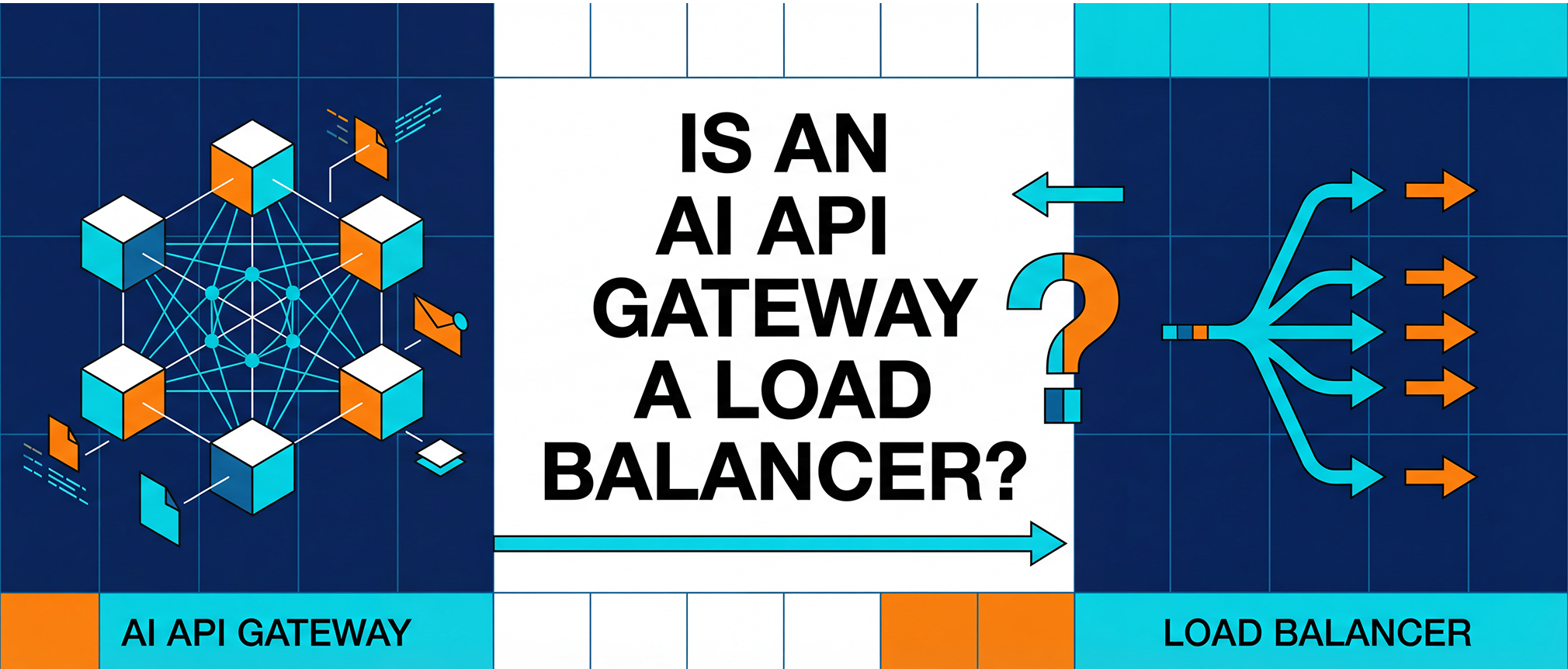
No — an AI API Gateway is not a load balancer.
While a load balancer distributes network traffic evenly across servers to ensure performance and availability, an AI API Gateway does much more. It acts as an intelligent control layer between AI-powered applications and backend AI services (like large language models, vision APIs, or speech engines), managing routing, authentication, cost control, monitoring, and data security.
In other words, a load balancer handles how requests are distributed, while an AI API Gateway governs what those requests mean, where they should go, and how they are processed, transformed, and audited.
Understanding the Role of an AI API Gateway
An AI API Gateway is a specialized middleware that connects front-end AI applications to backend AI services such as OpenAI, Anthropic, Google Gemini, or local LLM deployments.
It centralizes all AI-related communications and enables teams to:
- Authenticate and authorize API access
- Enforce data privacy and compliance
- Route AI traffic intelligently across providers
- Control token usage and prevent cost overruns
- Monitor latency, performance, and errors in real time
Unlike traditional gateways, AI API Gateways understand AI-specific semantics such as token limits, model versions, and prompt-response transformations. This makes them essential for organizations adopting multi-model or GenAI architectures.
How Load Balancers Work
A load balancer distributes incoming traffic across multiple servers to optimize resource usage and ensure high availability.
Here’s how it works:
- A client sends a request to an endpoint.
- The load balancer receives the request and selects a healthy server (using round-robin, least-connection, or IP-hash algorithms).
- It forwards the request to that server and returns the response to the client.
This approach keeps applications online even during server outages and scales automatically to match user demand.
However, a load balancer has no awareness of AI context — it only balances traffic at the network or HTTP layer, not based on model logic, token consumption, or prompt type.
AI API Gateway vs. Load Balancer: Key Differences
| Feature | AI API Gateway | Load Balancer |
|---|---|---|
| Purpose | Manages and secures traffic between AI apps and model APIs | Distributes network traffic across servers |
| Layer | Application/API layer | Network/transport layer |
| Capabilities | Authentication, rate limiting, observability, cost control, prompt moderation | Server availability, load distribution |
| Intelligence | Context-aware (token usage, model versioning, AI routing) | Context-blind (focuses only on balancing traffic) |
| Use Case | AI orchestration, multi-model routing, compliance | Web server load management, redundancy |
In short, a load balancer keeps systems available, while an AI API Gateway keeps AI systems governable and efficient.
When Do You Need Both?
In large-scale AI architectures, both components can work together.
A load balancer ensures infrastructure-level scalability, while the AI API Gateway provides intelligent orchestration across AI endpoints.
For example:
- The load balancer distributes requests between multiple instances of the AI Gateway service.
- The AI Gateway then routes each request to the correct AI model provider based on task type (e.g., summarization → GPT-4, vision → Gemini, speech → Whisper).
This layered approach ensures both operational reliability and AI-level governance.
Why AI API Gateways Are Essential for Modern AI Workloads
AI workloads introduce unique challenges that traditional load balancers can’t address:
- Data Security: Sensitive prompts or documents require encryption, masking, and auditing.
- Cost Optimization: AI models often charge per token — gateways can monitor and limit token consumption.
- Multi-Model Orchestration: Gateways dynamically choose which AI model to invoke based on task or cost.
- Compliance: They ensure data stays within approved regions or providers (e.g., GDPR compliance).
As AI becomes core to enterprise infrastructure, gateways are evolving to include observability dashboards, prompt moderation, and even AI-specific caching mechanisms.
The Future of AI API Gateways
Modern AI Gateways are moving beyond simple routing. They integrate with observability stacks, data governance tools, and AI orchestration frameworks. Future gateways will support:
- Policy-driven AI traffic management
- Token-based cost visualization
- Context-aware routing powered by AI agents
- Integration with Retrieval-Augmented Generation (RAG) and vector databases
This evolution positions the AI Gateway as the nerve center of enterprise AI infrastructure — not just a traffic router, but a strategic governance layer.
OpenQiao: The Next Generation AI API Gateway
OpenQiao exemplifies what the next evolution of AI API Gateways looks like.
It provides a unified gateway for teams deploying and scaling multi-model AI workloads. With OpenQiao, organizations can:
- Securely connect to multiple AI providers
- Monitor token usage, latency, and performance in real time
- Automate AI routing and failover between models
- Apply guardrails for safety and compliance
- Control costs through intelligent rate-limiting and quotas
Built for scalability and transparency, OpenQiao helps organizations deploy AI with confidence — balancing speed, security, and governance in one platform.