
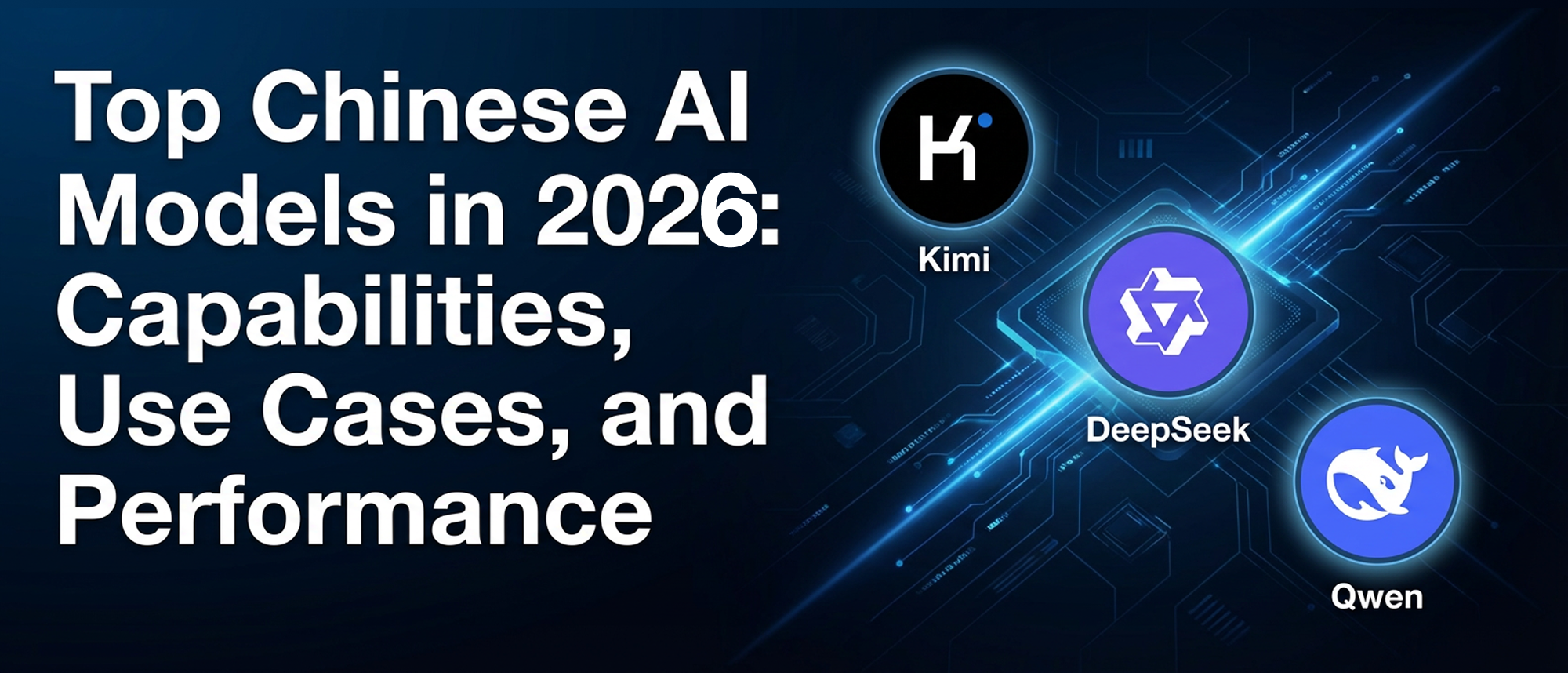
As we move further into 2026, Chinese AI models have solidified their place as global competitors, not just in terms of cost-efficiency but also in performance. The rapid advancements in natural language processing (NLP), multimodal capabilities, and coding abilities have set models like DeepSeek-V3, Qwen 3, Doubao 1.5 Pro, Kimi k2, and WuDao 3.0 apart from their Western counterparts. These models are designed to excel in a variety of fields—from text generation and coding to image and video processing.
In this guide, we’ll explore the latest versions of these AI models, their key features, use cases, and how they compare to other AI models in the market. Whether you're in the tech industry, education, or business, understanding these cutting-edge models is crucial for leveraging AI in your projects.
1. DeepSeek-V3: Master of Coding and Logical Reasoning
DeepSeek-V3, developed by Liang Wenfeng, remains one of the most efficient AI models in the market. With 671 billion parameters and a Mixture-of-Experts (MoE) architecture, it dynamically activates only the necessary parameters, ensuring high performance at a reduced computational cost. This model shines particularly in coding and mathematical reasoning, as well as long-form content generation.
Key Features:
- MoE Architecture (671B parameters with 37B active per input).
- Extended Context Length: Can process up to 128,000 tokens in a single input.
- Multi-Token Prediction: Speeds up response generation by predicting multiple tokens at once.
Use Cases:
- Automated coding and debugging for software developers.
- Legal document analysis, research papers, and technical writing.
- Real-time problem-solving in complex scenarios.
Performance:
- MMLU: 88.5
- MATH-500: 90.2 (excellent in mathematical reasoning)
- Codeforces: 51.6 (strong coding performance)
2. Qwen 3: Alibaba's Next-Gen Multimodal AI
Launched in 2026, Qwen 3 is the latest evolution of Alibaba Cloud’s AI. With a Mixture-of-Experts (MoE) architecture and the ability to handle text, images, and video, Qwen 3 is more powerful and cost-efficient than ever. It has been trained on over 20 trillion tokens, which enhances its ability to reason, generate code, and understand multimedia content seamlessly.
Key Features:
- Multimodal AI: Understands and generates text, images, and video.
- Extended Context: Capable of processing up to 128,000 tokens in a single pass.
- Cost Efficiency: $0.38 per million tokens, much cheaper than models like GPT-4o.
Use Cases:
- Multimedia content creation: Text-to-image, text-to-video, and video summarization.
- Automated code generation for Python, JavaScript, and more.
- Long-form document analysis for research and legal industries.
Performance:
- Arena-Hard: 89.4 (outperforms DeepSeek-V3 in user preference alignment)
- LiveCodeBench: 92.7% (excellent in coding tasks)
- MMLU-Pro: 83.0 (good at knowledge and reasoning)
3. Doubao 1.5 Pro: Deep Reasoning and High-Efficiency Processing
Developed by ByteDance, Doubao 1.5 Pro uses a Sparse Mixture-of-Experts (MoE) architecture, optimizing efficiency by activating only a fraction of its parameters at a time. This makes it highly cost-effective while maintaining strong performance in deep reasoning, coding, and multimodal processing.
Key Features:
- Sparse MoE Architecture: Significantly reduces computational costs.
- Extended Context Window: Can process up to 256,000 tokens for complex document analysis.
- Multimodal Capabilities: Supports text, vision, and speech.
Use Cases:
- Document analysis for legal, academic, and corporate sectors.
- Visual content understanding in fields like healthcare and media.
- Multilingual support, especially in Chinese and English.
Performance:
- DROP: 93.0 (exceptional in reading comprehension)
- BBH: 91.6 (high performance in complex reasoning tasks)
- C-Eval: 91.8 (strong performance in Chinese language tasks)
4. Kimi k2: Advanced Multimodal Integration and Long-Context Processing
Kimi k2, the upgraded version of Kimi k1.5, offers improvements in multimodal capabilities, particularly in handling both text and visual inputs. With 128,000 tokens of context length, Kimi k2 is ideal for industries requiring complex reasoning and analysis, such as medical imaging and financial analysis.
Key Features:
- Long-Context Processing: Handles up to 128,000 tokens.
- Multimodal Integration: Processes both text and images simultaneously, enabling applications in areas like medical imaging and financial data analysis.
- Chain of Thought (CoT) Reasoning: Enhanced problem-solving abilities with detailed reasoning steps.
Use Cases:
- Medical imaging analysis.
- Financial data interpretation and predictive modeling.
- AI-powered research in various scientific fields.
Performance:
- MATH-500: 97.4%, outperforming GPT-4o and Claude Sonnet 3.5 on math-related benchmarks.
- AIME: Leading performance in AI-based reasoning tasks.
- MATHVista: Demonstrates high proficiency in solving complex mathematical problems.
5. GLM-4 Plus (ChatGLM): Multilingual AI with Advanced Conversational Abilities
Developed by Zhipu AI, GLM-4 Plus (or ChatGLM) excels in maintaining multi-round conversations and understanding long-form dialogue. With an extended context length of up to 1 million tokens in its latest version, it offers strong multilingual support, covering 26 languages.
Key Features:
- Multilingual: Supports 26 languages, including Chinese, English, Japanese, and Korean.
- Extended Context Length: Handles up to 1 million tokens for processing long documents.
- Advanced Multimodal Understanding: Can generate and analyze high-resolution images.
Use Cases:
- Customer service and chatbot applications.
- Code execution and software development support.
- Multilingual content generation.
Performance:
- MMLU: Achieves 99–104% efficiency compared to GPT-4o.
- Math and Reasoning: Handles complex math and code problems effectively.
- AlignBench: Performs at a high level in user alignment and personalization tasks.
6. WuDao 3.0: Open-Source AI for Startups and Small Enterprises
WuDao 3.0, developed by BAAI, is designed for companies that need a cost-effective yet powerful solution. With support for both Chinese and English and multimodal capabilities, WuDao 3.0 can generate images from text, process visual content, and perform high-level text analysis.
Key Features:
- Multilingual Support: Works with both Chinese and English.
- Multimodal Capabilities: Text-to-image, image understanding, and text analysis.
- Open-Source: No licensing fees, making it an affordable option for startups.
Use Cases:
- Image generation and content creation for marketing and design industries.
- AI-powered search engines and knowledge retrieval.
- Language translation and chatbot applications.
Performance:
- SuperGLUE: Outperformed GPT-3 in few-shot learning.
- Text-Image Tasks: Better performance in image-text retrieval compared to OpenAI’s CLIP and Google’s ALIGN.
Final Thoughts: The Future of Chinese AI Models
With advancements like Qwen 3 and Kimi k2, Chinese AI models are positioned to play a key role in the global AI landscape. These models are not only cost-effective but also deliver exceptional performance across various domains like coding, multimodal processing, and complex reasoning. Whether you're building AI-powered products or automating workflows, these Chinese AI models provide powerful, affordable options.
开桥 integrates the latest Chinese AI models, including Qwen 3, providing seamless access to cutting-edge technologies in one platform. Its unique insurance payout mechanism compensates users for poor output quality or excessive latency, ensuring stability and reliability for enterprise applications. With intelligent detection of AI hallucinations and instability, 开桥 simplifies AI integration, delivering consistent, high-quality results for both large-scale and smaller projects—so you can innovate without worrying about performance uncertainties.