

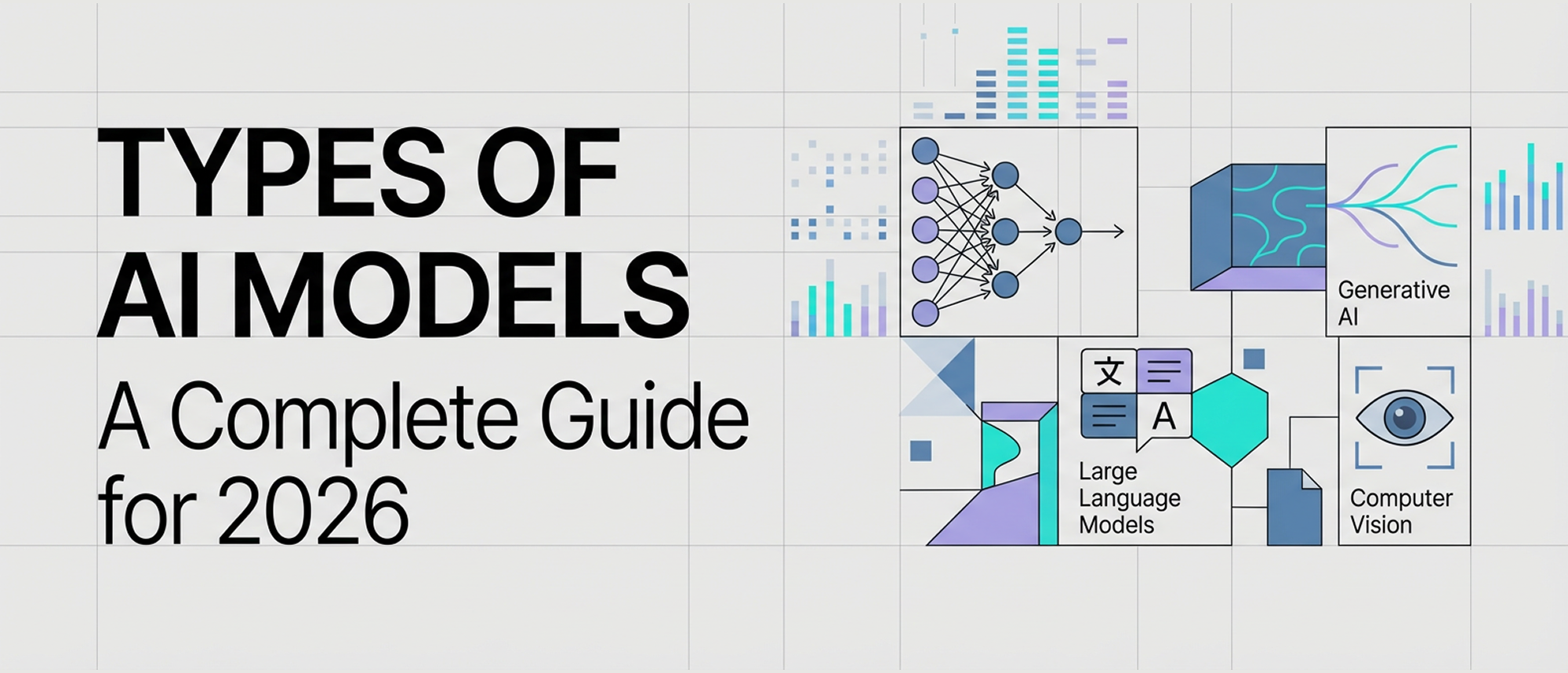
Artificial intelligence is reshaping the way we interact with technology, from digital assistants to self-driving cars. In this guide, we break down the different types of AI models, how they work, and when to use each type, helping developers and businesses leverage AI effectively in 2026.
With OpenQiao, accessing and experimenting with multiple AI models has never been easier. Using a single, unified API, developers can call different AI models seamlessly, whether for real-time tasks, deep reasoning, or multimodal applications, simplifying integration and reducing overhead.
What is an AI Model? Understanding the Core of Artificial Intelligence
AI models are essentially the “brains” of artificial intelligence. Built using algorithms and data, these models learn from experience to identify patterns, make predictions, and generate content.
Key capabilities of AI models include:
- Data analysis and pattern recognition
- Predictive decision-making
- Content generation
The accuracy of an AI model improves with more training data, allowing it to make better predictions and smarter decisions.
How AI Models are Created: Algorithms and Neural Networks
AI models are developed by data scientists using algorithms — step-by-step procedures designed to solve specific problems. When an algorithm is trained with data, it becomes an AI model.
Artificial neural networks (ANNs) mimic the human brain’s structure, enabling complex pattern recognition and decision-making. ANNs consist of nodes (artificial neurons) that process input data, analyze it across layers, and produce meaningful outputs.
Applications include:
- Image and speech recognition
- Natural language processing (NLP)
- Document summarization
- Complex decision-making
Machine Learning Models: The Foundation of AI
Machine learning (ML) is a core subset of AI. ML models are trained using labeled, unlabeled, or mixed datasets to recognize patterns and make predictions.
Common ML algorithms include:
- Classification: Categorizes data into predefined classes
- Regression: Predicts numerical values based on input variables
- Decision Trees: Uses branching logic to make decisions and predictions
Example: Teaching an AI model to identify different types of flowers using labeled datasets and pattern recognition.
Supervised Learning Models: Learning with Guidance
Supervised learning uses labeled datasets to train AI models. Each input has a corresponding output, helping the model learn relationships and make accurate predictions.
Example: Using images of flowers with species labels to train a model to correctly identify new flower images.
Unsupervised Learning Models: Learning Without Labels
Unsupervised learning enables AI models to identify patterns and group data without human-provided labels. Models create their own structures, making it ideal for exploratory data analysis.
Example: Grouping a dataset of flowers by characteristics like color and petal shape without predefined categories.
Deep Learning Models: Advanced Pattern Recognition
Deep learning is an advanced subset of ML, leveraging multiple neural network layers to analyze complex data patterns in text, images, audio, and video.
Key components of deep learning networks:
- Input layer: Receives raw data
- Hidden layers: Process and transform data through multiple stages
- Output layer: Produces final results
Applications include:
- Large language models (LLMs)
- Automatic facial recognition
- Fraud detection
- Virtual assistants and AI-driven tools
Common AI Model Examples
Machine Learning Models:
- Linear Regression: Predicts continuous values
- Logistic Regression: Binary classification tasks, e.g., spam detection
- Decision Trees: Classification and regression tasks
Deep Learning Models:
- Convolutional Neural Networks (CNNs): Image classification and object detection
- Recurrent Neural Networks (RNNs): Sequential data analysis, language modeling
- Long Short-Term Memory Networks (LSTMs): Captures long-term dependencies in sequential data
Reinforcement Learning Models:
- Q-Learning: Learns optimal actions in given states
- Deep Q Networks (DQN): Combines Q-learning with neural networks
- Policy Gradient Methods: Optimizes complex action policies
Applying AI Models to Real-World Applications
AI models can be applied to virtually any task: classification, prediction, natural language processing, content generation, and more. Choosing the right type of AI model depends on the task complexity, data availability, and performance requirements.
Simplify Multi-Model AI Development with OpenQiao
For developers and enterprises, OpenQiao offers a unified platform to access multiple AI models through a single API. This enables seamless integration, real-time experimentation, and intelligent model routing, while providing insurance-backed quality guarantees and full observability across model performance and usage.
OpenQiao ensures that your AI applications are fast, reliable, and cost-efficient without juggling multiple accounts or APIs.