

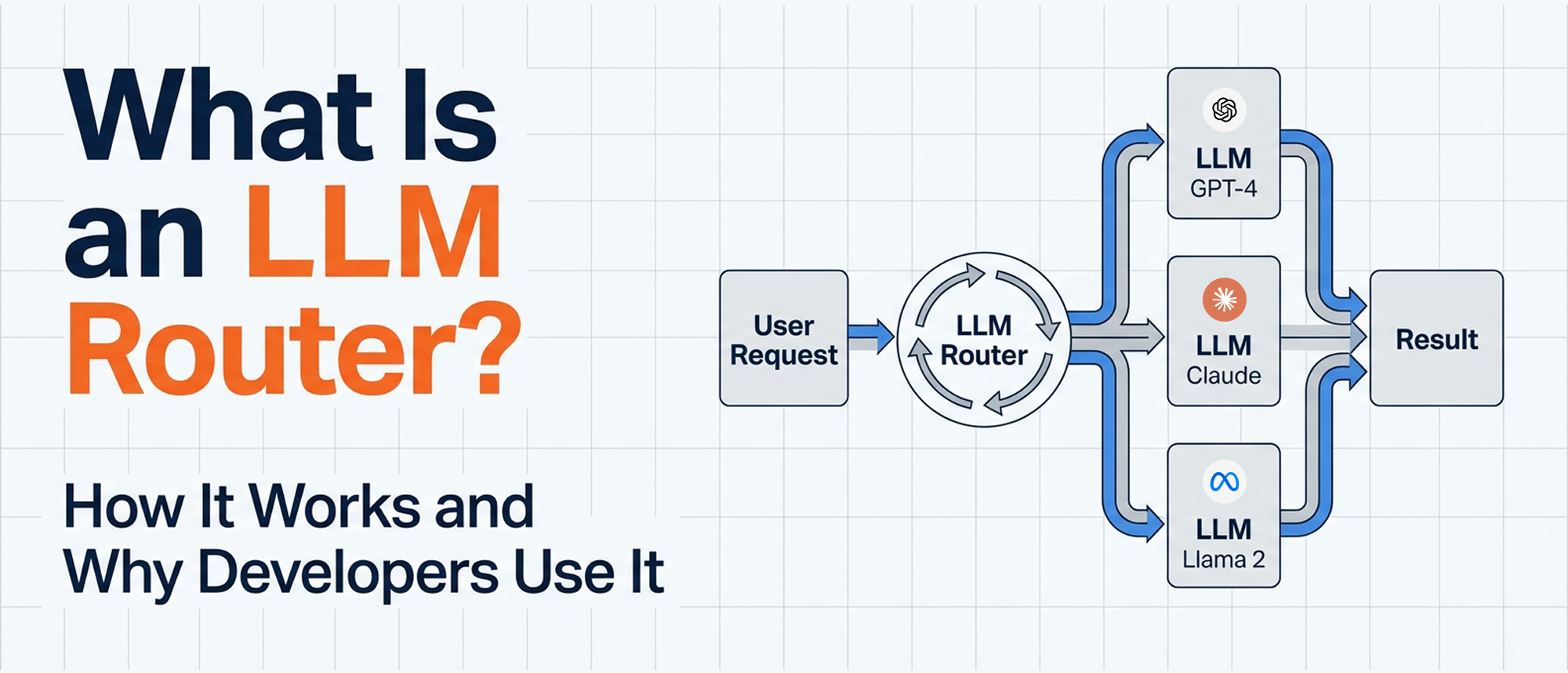
What Is an LLM Router?
An LLM router is a system that dynamically chooses the most suitable large language model (LLM) for every incoming task. Instead of relying on a single model for every query, an LLM router evaluates parameters like performance, cost, latency, and context type to determine which model can deliver the best possible output.
For example, a short factual lookup might be handled by a lightweight, cost‑efficient LLM, while a nuanced reasoning query or creative prompt may be routed to a more advanced model. The router’s core mission is simple: maximize performance while minimizing cost and risk.
In short, an LLM router is the intelligent decision layer that sits between your application and multiple large models—ensuring every query goes to the right AI brain.
Understanding Dynamic LLM Routing Technology
Dynamic LLM routing isn’t just load balancing—it’s context‑aware optimization.
Each incoming request passes through a classification layer that analyzes intent, complexity, and expected reasoning depth. Then, the router’s internal logic scores candidate models on key metrics such as:
- Accuracy and creativity
- Latency and throughput
- API cost per token
- Language coverage
- Availability and reliability
The router then forwards the request to the model with the highest composite score for that task. In advanced systems, this matching process is continuously refined based on user feedback, confidence scores, and past performance data.
Why LLM Routing Matters for Modern AI Applications
- Optimized Performance
Different LLMs excel at different types of tasks—some reason logically, others generate fluent content, while others shine in technical detail. Routing ensures every task reaches the best‑fit model. - Cost Efficiency
Premium models are powerful but expensive. A routing system ensures you only pay for top‑tier models when necessary, redirecting routine requests to smaller, cheaper LLMs. - Reliability and Resilience
If one model experiences downtime or performance degradation, the router can automatically shift traffic to alternative providers, guaranteeing service continuity. - Scalability
By orchestrating multiple models dynamically, enterprises can build scalable systems that respond to varied workloads without infrastructure reconfiguration.
How an LLM Router Works Under the Hood
Behind the scenes, an LLM router typically follows three stages:
- Input Classification – The router identifies the intent: summarization, coding, reasoning, translation, etc.
- Model Scoring – Based on metadata (latency, cost, performance benchmark), candidate models are scored.
- Dynamic Selection & Execution – The router sends the request to the highest‑scoring model and monitors the response for quality and timing.
More sophisticated routers employ reinforcement learning or meta‑optimization layers that improve routing decisions using historical performance data and user satisfaction metrics.
Real‑World Example: Routing in Multi‑Model Architectures
Imagine you’re developing a customer experience platform.
- When a user asks a simple question like “What are today’s business hours?”, the system routes it to a lightweight inference model.
- When another user asks “Can you rewrite this technical proposal for a finance audience?”, the same router sends the query to a high‑end LLM specialized in writing and context adaptation.
This ensures users always receive the best‑quality response—without unnecessary delay or cost overhead.
LLM Routing Platforms and Why Developers Use Them
Modern LLM routing platforms abstract away provider complexity. They connect developers to multiple large models—from OpenAI, Anthropic, Google, Qwen, Moonshot, and others—through a single API layer.
Developers use these routers because they:
- Simplify multi‑provider integration
- Provide benchmarking tools to compare model behavior
- Offer built‑in fallbacks and routing logic
- Reduce infrastructure overhead
Essentially, routing platforms make AI orchestration accessible without deep MLOps complexity.
Beyond Routing: The Future of Reliable AI Infrastructure
The next evolution of LLM routing merges intelligent orchestration with quality assurance. Instead of simply forwarding queries, next‑generation routers monitor the semantic quality of each response, detect hallucinations, and even issue automatic compensations for poor output quality—making AI consumption safer for enterprise production environments.
OpenQiao: The Smartest LLM Router with Built‑In Assurance
This vision is already a reality with OpenQiao—the world’s first enterprise‑grade AI API gateway that not only aggregates the world’s top LLMs but also integrates an LLM insurance mechanism.
OpenQiao’s routing engine intelligently directs each request to the most suitable model while continuously monitoring quality and latency. If an output fails to meet expected standards, OpenQiao’s unique insurance payout system automatically compensates users—so you truly pay for results, not hallucinations.
OpenQiao removes the friction of model management. Developers can focus on innovation—knowing every request is optimized, insured, and production‑ready.
Final Thought
As AI ecosystems continue to diversify, LLM routers will become the backbone of scalable, cost‑efficient, and reliable AI architecture. Platforms like OpenQiao are leading this evolution—turning the complexity of multi‑model orchestration into a simple, stable, and insured experience.